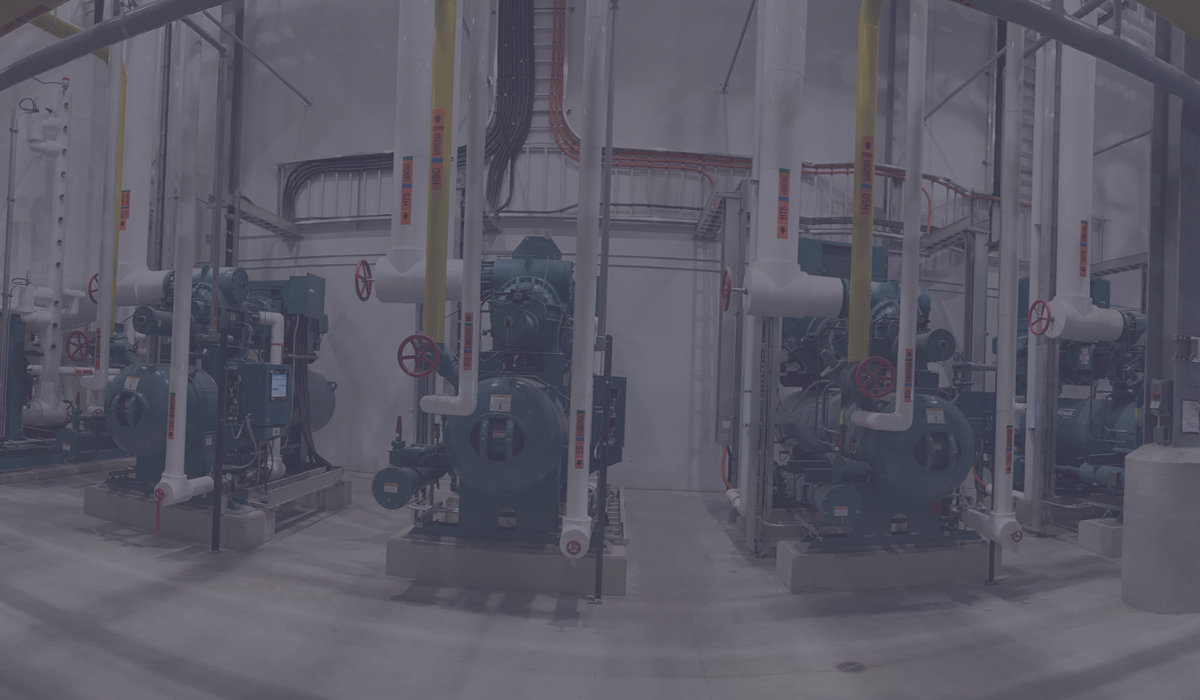
The large retail chain’s $175-million grocery distribution center opened at the start of 2022 and provides ambient, fresh, and frozen grocery goods to 45 stores in BC.
As commercial properties are particularly expensive in BC, the retail chain opted for a special 66ft tall (20m) vertical automated storage and retrieval system, allowing it to reduce the land needed for the facility by half. To design a system fit for this facility, one that would further add to the space reduction, CIMCO applied some out-of-the-box thinking to come up with the right solution.
The result was a new CO₂ refrigeration system design developed to support efficient operation and long-term performance, offering customers a reliable solution for their facility.
Sustainability Matters
The DC was built with sustainability in mind and aims to achieve minimal waster, according to the retail chain. The HVAC&R system aligns with these goals thanks to the selection of natural refrigerant CO2 and the enhanced energy-saving potential through built-in waste heat reclaim on the refrigeration system.
“Achieving the Province’s legislated GHG (greenhouse gas) reduction targets requires a shift towards low-carbon heating options and the highest performing buildings,” he said. “This new facility, featuring state-of-the-art technology that focuses on sustainability and achieving zero-waste, is a big step in the right direction.”
.png?sfvrsn=dedadd22_1 "CIMCO Refrigeration - Commercial HVAC (1)")
CO2 Comes Out on Top
CO2 refrigeration is ideally suited to cooler climates, allowing for optimum energy efficiency gains. This makes the province of BC with its cool climate particularly suited to this technology.
The retail chain was already familiar with using CO2 in its retail applications and was enthusiastic to try it in a larger, industrial format for its new DC as well.
CIMCO compared various refrigerant solutions for this project and found that the upfront equipment costs and labor costs of the CO2 solution were comparable to those of a conventional ammonia system. However, when considering the full life-cycle cost, the CO2 system showed lower maintenance costs and an estimated energy savings.
Policy-wise, using a natural refrigerant like CO2 removes the risk of premature replacement of the refrigeration system, as the ongoing refrigerant phase-out threatens more conventionally used fluorinated refrigerants.

System Benefits and Savings
CIMCO designed a bespoke distributed transcritical CO2 rooftop package system for the new DC. It comprises six individual rack systems with a total capacity of 717 TR (2.5 MW).
The capacity is divided as follows:
· 54 °F (12 °C) Cooler: 77 TR (271 kW)
· 34 °F (1 °C) Cooler: 450 TR (1.6 MW)
· Freezer: 190 TR (668 kW)
The refrigeration system comes complete with built-in heat recovery. This means that waste heat from the refrigeration system is captured and used for various HVAC needs, such as the underfloor system and air curtains for doors and conveyors. This results in an additional saving on the utility bill.
In an unconventional move, there is no engine room on-site to house the cooling equipment. The refrigeration systems are actually positioned on the facility’s roof, 10 stories up. Each system comes complete with an outdoor enclosure to protect against the elements. Pre-fabricated penthouse units serve the cold rooms, housing the cooling coils and adiabatic gas coolers.
“By having the serviceable equipment on the roof, the retailer forwent the need for a plant room and saved valuable space inside the facility,” explained Rob Martin, Refrigeration Engineer at CIMO Refrigeration. “Having it on the roof also ensures that future maintenance will not impede operations inside the facility.”
Another benefit of this unique design is that the large refrigerant charge is now split across six systems, reducing the risk of leaks or downtime. Splitting the systems was also necessary to enable crane-lifting the equipment 10 floors up, a big challenge in itself.
Because much of the equipment and components could be prefabricated, the construction process could be expedited, saving time and money.
"This innovative CO2 packaged system we designed demonstrates the potential of CO2 refrigeration for industrial applications, especially in cooler climates like BC. This project showcases how out-of-the-box thinking can lead to efficient, cost-effective, and environmentally friendly solutions," concludes Martin.
Related Posts
Industrial Heat Pumps are the Past, Present and Future
Interconnected Efficiency: Leveraging Ammonia Heat Pumps for Sustainable Manufacturing